Day 2, Tokyo
“Just come out the south entrance. I’m elevated on some stairs right out front”
Navigation in Tokyo is remarkably intuitive. As long as you have a smartphone, Google Maps, and can follow giant color-coded arrows and markers throughout the train stations, you have a high chance of getting where you intend to go. Many times the hardest part of coordinating our group of eleven was picking each other out in a crowd, so it helps to be a tall foreigner. Max arrived to the platform at Tokyo Disneyland first, so he found a spot on some steps and sent the following photo to our group chat. Brittney and I are just below ground-level at this moment, having just arrived at Maihama Station along with the throngs of tourists and locals all very excited for a day at Disneyland.

I can’t talk about our trip to Japan without talking about the trains. The incredible trains. The fast and efficient people-movers that we relied on to get us from Point A to Point B every day. How easy it was, even to complete foreigners.
I have to give major props to Google Maps here. In the states, Google Maps does a pretty okay job at telling you roughly how long it will take to drive from one place to another, with a rough idea of how much traffic and slowdowns to expect. In Japan, Google Maps tells you what entrance of the train station you want to enter through, which platform the train will arrive at and when, which car to board on to make your connections easier, which gate you’ll exit out of so that you come out on the correct side of the street, and how much you will pay in fare to make the trip. It does all of this with real-time updates on disruptions and delays, and if Google Maps tells you the train is going to arrive at 8:26AM, you can be sure that it will arrive at 8:26AM.

I also want to highlight the user-friendliness of “the world’s most extensive urban rail network.” Note that each train segment in the photo above has a specific color, line, and two letter code. These indicators tell you what train to take, and they are posted all over every wall, column, and sign within the stations. If Brittney is navigating, all she has to tell me is “we’re getting on the yellow JB line, platform 2” and I suddenly have all the information I need to find the train. Many of the larger stations (more complex and more crowded with hurried passengers) even have these colored stripes painted on the floor underneath you, as if the floor itself is one big map guiding you in a neat line of people all heading to their next train.
It also helps that the crowds of people catching these trains are exceedingly polite and orderly, bound by the many unspoken codes of conduct of the railways. Everyone walks on the left side of the walkway; no pushing and shoving; stand in a single file line on the left side of the escalator so that people in a hurry can walk past on the right side; no eating or drinking on the trains; absolutely no littering. Everyone waits for the passengers getting off a train before boarding on. Even when the cars got crowded, no one was rude about it. A simple sumimasen (“excuse me”) is more than enough if you find yourself needing to squeeze through to get off at your stop.
Oh right this is supposed to be a post about Disneyland.

So we spotted Max almost immediately, and just a few trains behind us were the rest of our crew. We coffee’d up at a nearby Starbucks and joined the herd making its way for the gates.

There are a lot of people in Tokyo. We had arrived after gates opened but still early enough that the “get in line before rope drop” hadn’t all gotten through yet, so this was the first of many waiting periods for our day. If we’d planned a little better, or understood the nuances of the don’t-call-it-a-fastpass fastpass system, this would’ve been prime time to start reserving time slots for some of the more crowded attractions that we wanted to hit. But we are not professional Disneygoers so stand in line we did.
Many of the rides and attractions at Tokyo Disneyland are more or less the same as their counterparts in Walt Disney World, except that all of the characters speak Japanese. You’d think that would’ve been obvious to me? We’re in Japan, of course the characters aren’t going to speak in English. The one that caught me the most off guard was on Star Tours, a Star Wars-themed virtual coaster, and y’all… the anxious panic of C-3PO in Japanese was one of the highlights of my day.
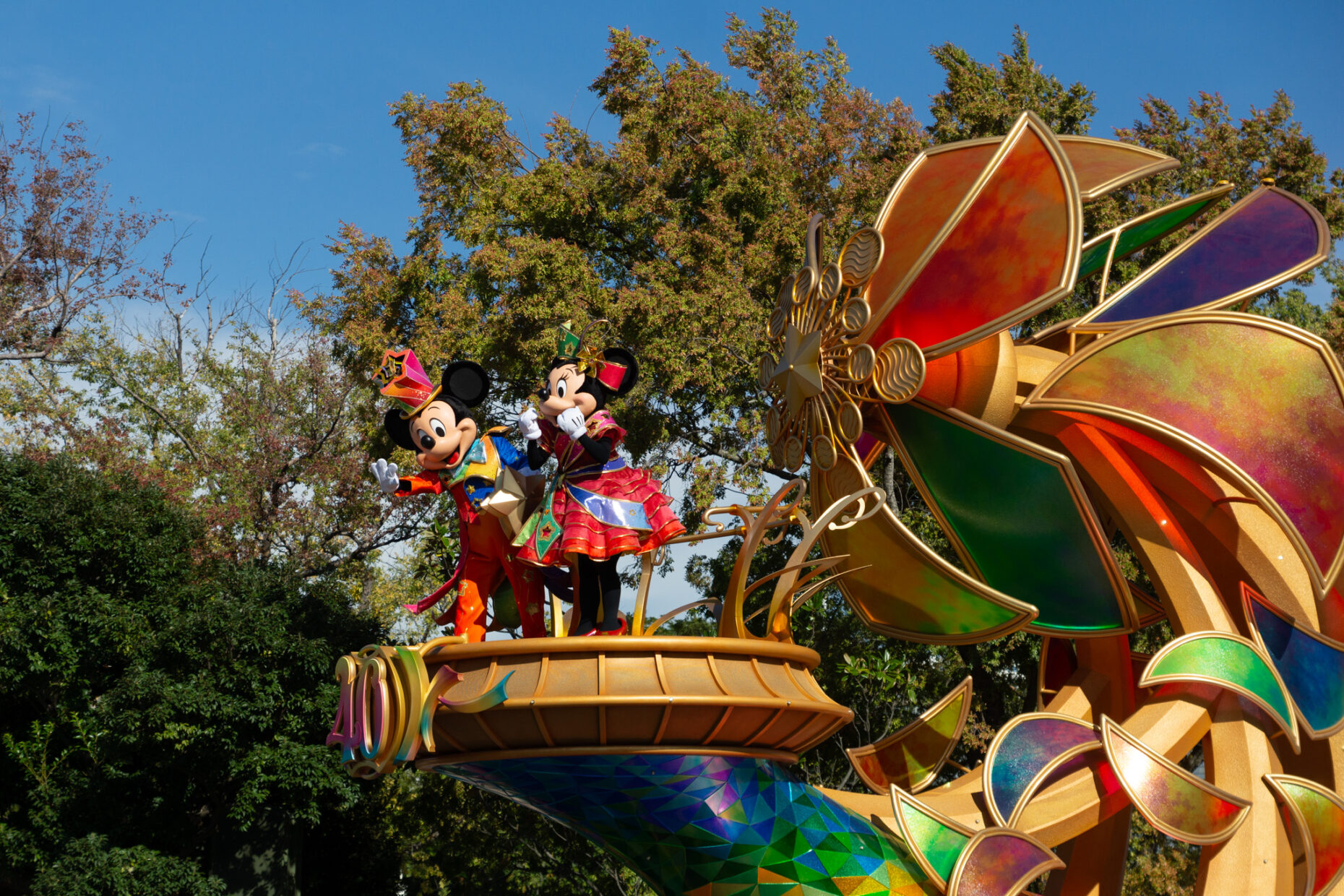
But if the parades at Walt Disney World are over-the-top, the parades at Tokyo Disneyland are on a different planet. Guests brought picnic blankets and started camping out in prime parade-viewing locations HOURS before they started. There are parade-specific rules and etiquette to follow: no kids on shoulders to block your view here.


And the popcorn.
Oh. My. Goodness. The popcorn.
Eighteen popcorn vendors and stands, some taking up an entire building to themselves. Many had their own unique flavor of popcorn, as well as their own unique souvenir popcorn containers. These containers come on a lanyard that you wear like a giant necklace, a la Flavor Flav. We figure that a lot of these containers are limited-time ordeals, so the hype among local Disney regulars is well… poppin. We chose a Monster’s Inc themed container filled with the salted caramel flavor. Some of the doors on the container even open to reveal little windows into the popcorn. It was warm and delicious and we snacked on it all day long.

In fact, we ate a lot of food.


And of course, we took adorable photos.

And to cap off the evening our eyes were delighted by the Tokyo Disneyland Electrical Parade Dreamlights. Which is somehow even more magical than the name implies. It’s a night parade with floats entirely constructed of lights that that dance and dazzle and… yeah photos don’t do it justice at all. But I tried. The rest of this post will just be Electrical Parade Dreamlights photos. ✌


Leave a Reply